This is the version for humans. We're also building one for your agents.
A book by David Arnoux
GTM OS
The operating system for go to market in the build era
Drop your email. You get the first chapter when it comes out.
You are on the list.
Chapter one goes to the day it comes out.

Cover, page 1 of 486
Hover the edges or click to turn the page.Swipe or tap the edges to turn the page.
The 2027 edition
What's inside
Every number on this page is counted from the book itself.
- 486pages
- 8parts
- 15chapters
- 86numbered figures
- 23worksheets
- 40motion cards
- 16workflows
- 15trends
- 13stories from history
- 35Easter eggs
The contents
Two phases and a part you hand to your CFO and your CIO. Diagnose first. Then build.
Before you start
- Thanks3
- Boston, 18068
- How This Book Works10
- GTM OS Canvas14
- The big points in this book16
- A letter from the end of 202720
Phase 1
Diagnose. Where are you going and where are you today?
Part One Foundations 23
- Ch 1We are all building decision support systems now26
- Ch 2Fifteen trends I would bet on42
Part Two Where you are going 65
- Ch 3Picture your GTM team at the end of 202766
Part Three Where you are today 87
- Ch 4How you work today88
- Ch 5Listen before you change anything102
- Ch 6Find your gaps and choose where to start118
Phase 2
Build. Go, go, go.
Part Four Architecture 147
- Ch 7Own your rules and buy the rest148
- Ch 8Draw your architecture one box at a time164
Part Five Operating model 185
- Ch 9Put the right people in the right seats186
- Ch 10Run the change one unit at a time202
Part Six GTM motions 219
- Ch 11Thirty GTM motions and who runs each one220
- Field guide238
Part Seven Running and scaling 345
- Ch 12What it looks like when it runs346
- Ch 13How you scale it358
The stakeholder part
Hand these to your CFO and your CIO.
Part Eight For your CFO and your CIO 367
- Ch 14For your CFO368
- Ch 15For your CIO382
At the back
- Start this week399
- Workbook, 23 sheets400
- The Easter eggsyou'll have to look
Coming with the book
The book is the human version. We're also building one for your agents and a codebase to go with it.
In the works
The book
For you and your team. Worksheets, figures and a canvas you fill in together.
In the works
The codebase
To build your own GTM OS, with ready skills and agents.
In the works
The agent version
The same book, written for your agents to read and run.
A pile of pages
Real pages from the book. Tap one to see it bigger.
All 86 figures
Every caption says what the figure shows, the lesson and what to do next.
- Fig I.1The chain reaction in three steps
- Fig I.2The adoption curve after Everett Rogers
- Fig I.3One small request at two speeds
- Fig I.4The four lanes buyers use now
- Fig 1.1Four stages of a GTM team
- Fig 1.2A context engineer works in laps
- Fig 1.3Four ways a buyer reaches your product
- Fig 1.4Your decisions sorted by cost and how often they come back
- Fig 1.5A router picks the provider for each request
- Fig 3.1Each quarter asks what has to be true by then
- Fig 3.2The GTM Vision Canvas runs in a fixed order
- Fig 3.3Every tool comes up for renewal before 2027 ends
- Fig 3.4One week today and one at the end of 2027
- Fig 4.1Your team mapped from the number down
- Fig 4.2A typical B2B data map
- Fig 4.3Your own data map to fill in
- Fig 4.4Fourteen steps on the road to GTM run by AI
- Fig 5.1Three people describe three different businesses
- Fig 5.2The weeks before anything gets built
- Fig 5.3Fill rates from a CRM export
- Fig 5.4Three questions for every slow step
- Fig 6.1The two pages on the table after week one
- Fig 6.2Your AI gap analysis
- Fig 6.3The gap sheet filled in for a scaleup
- Fig 6.4What a 0 and a 3 look like for each gap
- Fig 6.5How a leader and a team score the gaps
- Fig 6.6Where the book picks up each gap
- Fig 6.7Where the biggest gap sits in each type of company
- Fig 6.8Five starts at once or one start
- Fig 6.9The first ninety days on one start
- Fig 6.10An enterprise built around its CRM
- Fig 6.11A scaleup on a marketing suite
- Fig 6.12An enterprise on one office suite
- Fig 6.13A product led company
- Fig 6.14An AI native company on one database
- Fig 6.15Four architectures to aim for
- Fig 6.16Five questions that point to your architecture
- Fig 6.17Five profiles that come back in every audit
- Fig 6.18Every point tool keeps its own copy of the customer
- Fig 7.1Six layers of a GTM stack
- Fig 7.2The buy or build test
- Fig 7.3One thin layer of rules at three sizes
- Fig 8.1The end state box by box
- Fig 8.2One real tool under each job
- Fig 8.3The same five columns at a scaleup
- Fig 8.4The same five columns at an enterprise
- Fig 8.5Setup time and the monthly bill for four architectures
- Fig 8.6Two kinds of platform requirements
- Fig 8.7A stress grid for your platform
- Fig 9.1Three things to have before the first build
- Fig 9.2The first six months
- Fig 9.3Four function backlogs side by side
- Fig 9.4Three ways to govern who builds what
- Fig 9.5A field of prototypes nobody connects
- Fig 9.6Eight central seats at three sizes
- Fig 10.1John Kotter's eight steps for leading change
- Fig 10.2Two ways to put agents into one process
- Fig 10.3A short build with three people per function
- Fig 10.4Build the shared part once
- Fig 11.1Thirty motions in five groups
- Fig 11.2Five motions that keep a person at the centre
- Fig 11.3Two funnels side by side
- Fig 11.4Channels by speed and size of payoff
- Fig 12.1Five rhythms of a running system
- Fig 12.2Three lights on every running system
- Fig 12.3Two loops that check what agents make
- Fig 13.1Six steps to scale
- Fig 13.2Two units on one shared layer
- Fig 13.3Four things that break when a second unit joins
- Fig 14.1Two 2026 surveys on AI returns
- Fig 14.2Four ways saved hours turn into money
- Fig 14.3What one result really costs
- Fig 14.4Token prices fall and the bill still climbs
- Fig 14.5Two comparable groups over the same weeks
- Fig 14.6Ninety days on one use case
- Fig 14.7Kill, fix or scale at day ninety
- Fig 14.8The one page your CFO gets every month
- Fig 15.1The enterprise stack
- Fig 15.2The strictest enterprise setup
- Fig 15.3The scaleup stack
- Fig 15.4The strictest scaleup setup
- Fig 15.5The AI native stack
- Fig 15.6Three agents with three powers each
- Fig 15.7The strictest AI native setup
- Fig 15.8Sixteen boxes named by the job they do
- Fig 15.9What an attacker gets from each box
40 GTM motions in five groups
Thirty motions in chapter 11 and ten more in the field guide. Each one gets its own card spread. New in the field guide
Group A Find and rank 7
- 1Scoring
- 2Enrichment
- 3Signals and intent
- 4Data quality
- 5Competitor intel
- 6Review mining
- 36Champion tracking
Group B Reach 13
- 7Outreach
- 8Performance ads
- 9SEO and AI search
- 10Content and copy
- 11Social
- 12Newsletter
- 13Webinars and events
- 31Employee voices
- 32Video shows
- 33Reddit and forums
- 34Posts plus outreach
- 35Creator affiliates
- 39Free tools
Group C Sell 8
- 14Sales
- 15ABM
- 16Meeting briefer
- 17Business case
- 18Pricing tests
- 19Partners and referrals
- 37Inbound response
- 38Proof and pilots
Group D Keep 6
- 20Lifecycle
- 21Onboarding
- 22Churn radar
- 23Community
- 24Voice of customer
- 40Expansion signals
Group E Measure 6
- 25Attribution
- 26Forecasting
- 27Reporting
- 28Experiments
- 29Win-loss
- 30Monitoring
15 trends I would bet on
Chapter 2. Tick the ones you agree with.
- 1Writing and maintaining code costs close to nothing
- 2Personal AI agents start making purchases for us
- 3Usage pricing starts replacing the seat licence
- 4Plain text skills files become your team's playbook
- 5Your team builds GTM tools it used to buy
- 6AI-native and scale-up GTM teams get their own engineers
- 7Your GTM system learns from its own results
- 8Your buyer's agent reads your site before your buyer does
- 9Every business needs a front door for agents
- 10Your own agent takes the first conversation with a buyer
- 11When everyone automates outreach, the channels you can't automate win
- 12Campaigns run on live signals
- 13The CRM shrinks to a database your agents read and write
- 14Small GTM teams carry the revenue big teams used to
- 15Every agent that touches a customer gets tested before it ships
16 workflows
Motions chained into one job, start to finish.
- 1Find your first customers
- 2Launch a new product
- 3Get named in AI answers
- 4Hand your best self-serve users to sales
- 5Reach buyers through audiences other people built
- 6Clean your customer data
- 7Add a second source of pipeline
- 8Answer every inbound lead within minutes
- 9Sell more to the customers you have
- 10Win back lost deals and quiet customers
- 11Get pipeline from one event
- 12Win a few hundred named accounts
- 13Get pipeline through partners
- 14Enter a new market
- 15Keep customers renewing in a regulated industry
- 16Win big deals with a pilot
23 worksheets
Your homework. Every chapter opens with one.
- 1Your map of important decisions
- 2Which of these 15 bets do you agree with?
- 3GTM Vision Canvas
- 4Your whole GTM team today on one page
- 5Where is your company on the AI ladder?
- 6Compare the company's goals with your sponsor's goals
- 7Check you can ship before you start
- 8Plan who to interview
- 9Say what you found in two minutes
- 10Map where your GTM data lives
- 11Price the slow steps and delete first
- 12Sort every workflow you run today
- 13Five numbers about your data
- 14Find your gaps and choose where to start
- 15Build or buy this tool
- 16Draw your architecture one box at a time
- 17Name the seats
- 18Track every use case from scope to live
- 19Sort your thirty motions and pick two
- 20Your weekly run sheet
- 21Score your end of 2027 bet
- 22Price one use case for your CFO
- 23Draw where your data lives and moves
13 stories from history
Each chapter opens with a true one, sources listed.
- 11962 Katherine Johnson
- 21965 Gordon Moore
- 31903 Roald Amundsen
- 41858 Florence Nightingale
- 51970 William H. Whyte
- 61977 Albert Szent-Györgyi
- 71981 The IBM PC team
- 81941 Beatrice Shilling
- 91943 Tommy Flowers
- 101718 Lady Mary Wortley Montagu
- 111951 Brownie Wise
- 121924 Sakichi Toyoda
- 131922 Lewis Fry Richardson
Read a few pages
Four spreads and a few lines, exactly as they appear in the book.

“One person learned to make fire. The rest of the tribe set up a steering committee.”
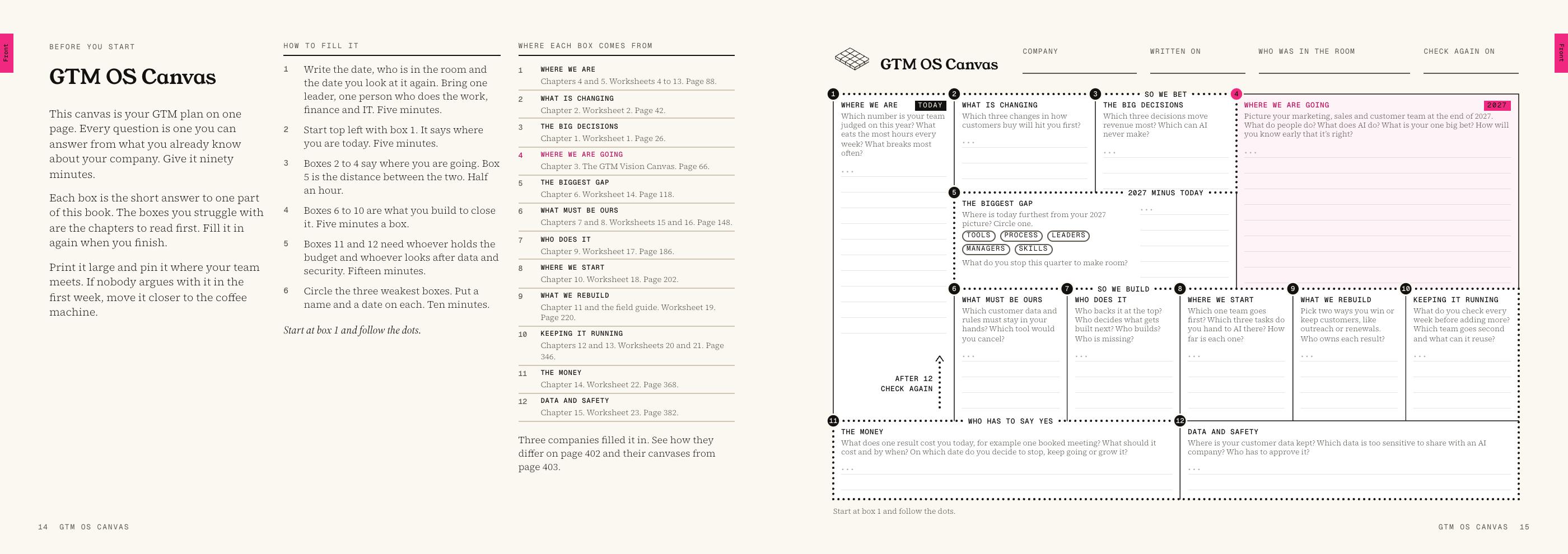
“If nobody argues with it in the first week, move it closer to the coffee machine.”
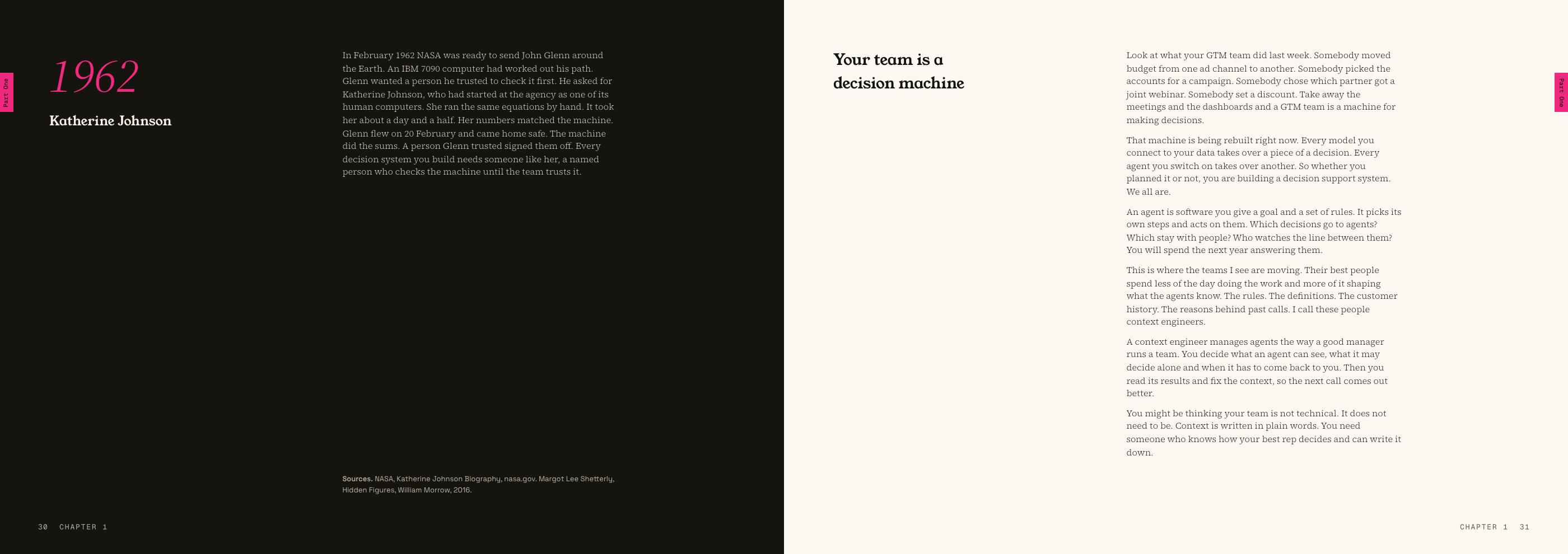
“A light that alerts nobody is a dashboard.”
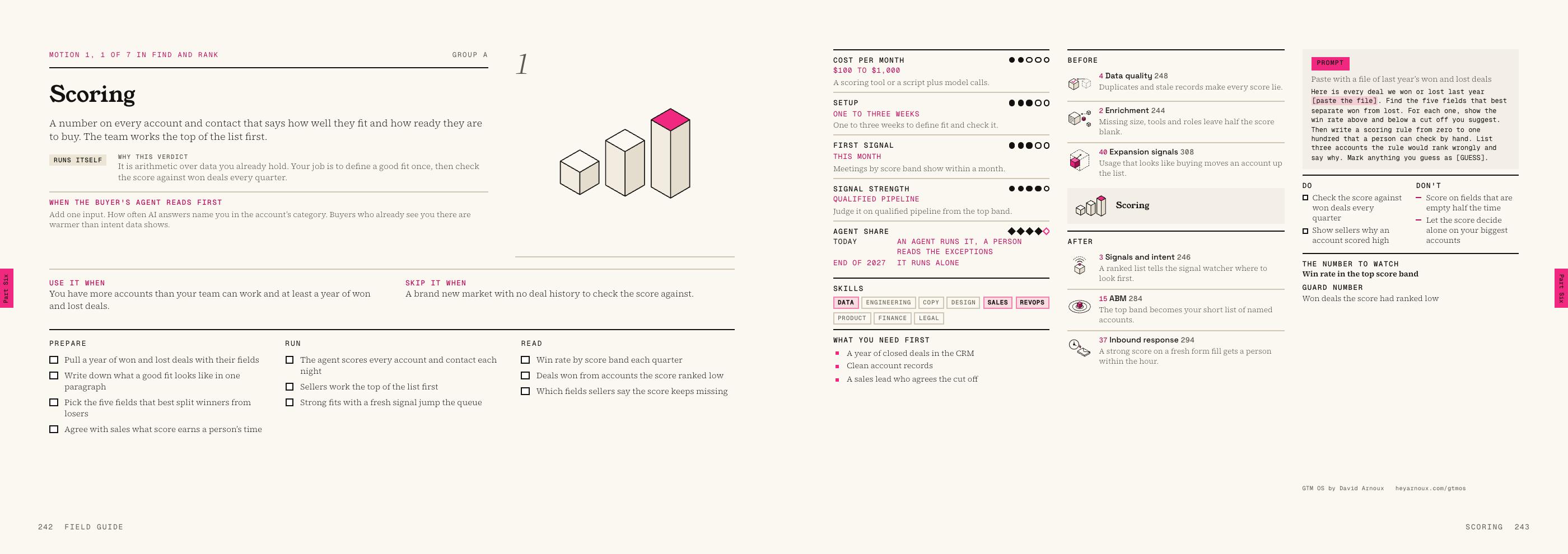
“Approving every output by hand is the most expensive way to buy quality.”
“A pilot with no end date is a subscription.”
Who it's for
You run GTM, or a big piece of it. Marketing, sales, partnerships or revenue operations. You can see AI changing how your team works and you want a plan you can defend in front of your CEO, your CFO and your team.
You don't need to be technical. Every chapter starts with homework you can fill in from what you already know. The workbook at the back has every sheet filled in for three types of company, so you follow the one closest to yours.
By the last page you have your own GTM OS Canvas, one gap to start on and a first build. Already know where you stand? Skip to page 147 and start building.
Chapter one
Drop your email. You get the first chapter when it comes out.
You are on the list.
Chapter one goes to the day it comes out.